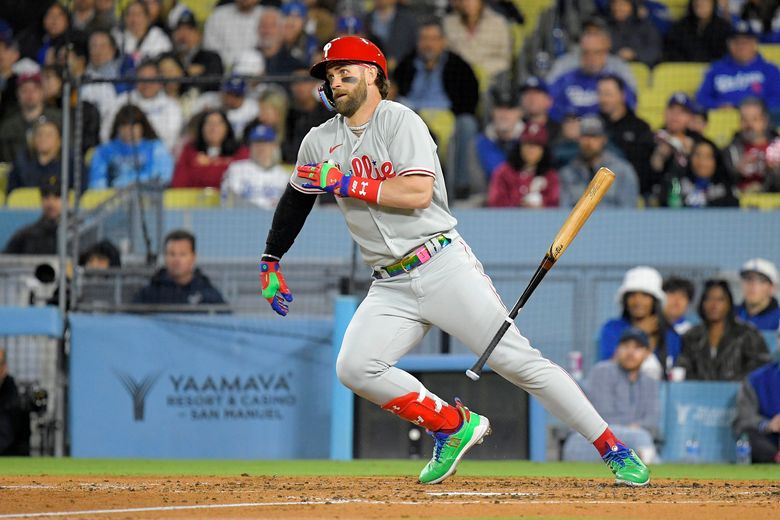
So far in 2023, we’ve seen many new things begin happening. For example, with commissioner Rob Manfred’s rule changes, stolen bases, offense, and times of games have all improved drastically. But, on the mechanics side of things, one new style of hitting is becoming more and more normalized among players, the two-strike approach. Players such as Bo Bichette, Carlos Correa, Trea Turner, Shohei Ohtani, and more have not only mastered the two-strike approach, but have begun implementing it into all of their counts. What is the reason behind this? How effective can it be? Today, we’ll be taking a deep dive into the switch from leg kicks, to two-strike style hitting, and everything to do with the two-strike approach.
Explaining the Two-Strike Approach
The two-strike style of hitting, is where the hitter changes from his normal load, (typically a leg lift) and switches to an expanded base, and shortened load. Typically, the expansion of the hitters base goes to about where they would typically land once their front leg is on the ground following their stride. This expansion, and two-strike setup is typically used to eliminate movement in the hitter’s load, and other potential mistakes when it comes to timing. Although simple, this adjustment really helps hitters see the ball much, much better, typically helping them to battle in two-strike counts better than if they were to keep their original approach. Eliminating movement, as previously mentioned, removes a lot more room for error, and especially in two-strike counts, this is an incredibly valuable asset for hitters to possess.
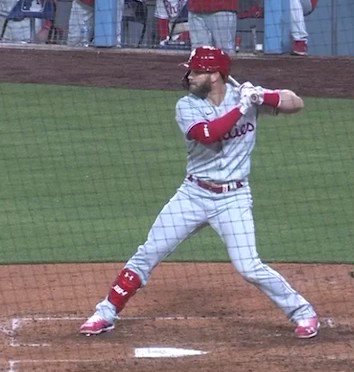
Hitters who have seemed to make this transition into baseball include, Bo Bichette, Bryce Harper, Carlos Correa, Dylan Crews, Trea Turner, Shohei Ohtani, and plenty more. Making this transition has helped Bo Bichette especially, focus on making more contact in two-strike counts, eventually leading to more hits, which has certainly helped him lead the AL in hits numerous times.
Why are Hitters Changing their Approach?
The last decade of baseball has brought many changes to the mechanical side of the game, but nothing has been more noticeable than the leg kick and leg load style of hitting. This style of hitting was originally popularized by hitters such as Josh Donaldson, Bryce Harper, and many more. Originally, the goal of the leg kick was to let the hitter keep their rhythm in the batters box, while also engaging their lower half in hopes of boosting power numbers.
This standard of hitting was really successful, and worked for many hitters, but, as time moved on and pitchers began throwing 100 miles per hour more often, hitters began to end up later more often than ever. Another downside to this style of hitting was the sheer amount of motion that occurred during the load, sometimes throwing hitters off completely. Especially in two-strike counts where the hitter needs to battle more than ever, this combination of movement and specifics when it came to timing made it very difficult for hitters to battle, especially once they saw faster pitching.
Being the advanced big-leaguers they are, hitters naturally realized they needed a solution. What was this solution? The two-strike approach. Hitters realized that they could shrink their motion by starting with their front leg already in a position to launch from, but could still have rhythm by keeping the motions to a minimum. Again, this slight adjustment lets hitters retain their rhythm, but also keeps their movement to a minimum, making it easier to battle in two-strike counts.
But, as the rise in velocity continues to occur all across baseball, hitters have begun exploring this shrink in motion in order to combat the triple digit fastballs. This ultimately has led to far more hits in two-strike counts, and more balls in play, proving that this approach will certainly be valuable.
How is this Valuable in Non Two-Strike Counts?
So far, we’ve shown what sparked the implementation of the two-strike approach, but how exactly is this valuable in non two-strike situations? As we previously established, MLB is in the midst of a significant climb in velocity, with more players than ever throwing triple-digit fastballs. And, the two-strike approach is built perfectly to minimize the effect of high velocity on hitters. So, with this combination we can easily see how the two-strike approach will be valuable in non two-strike counts, from a velocity standpoint alone.
Also, with the rise in pitchers throwing devastating breaking balls, hitters need as much time as possible to see and read the incoming pitch’s spin. What’s the best way to do this? Limiting movement while the ball is on the way, and stabilizing the head. This is another clear reason as to why hitters will implement this approach into their entire game, and not just two-strike counts.
Another reason I could see this being fully implemented in all counts is that with the shift being restricted, more balls have potential to get through, and find holes. With the two-strike approach being more contact driven, hitters should put many more balls in play with this approach at play. So, what better way to focus on putting the ball in play than limiting movement, and focusing on doing just that through the two-strike style of hitting.
Who Has Implemented the Two-Strike Approach so Far?
The two-strike approach has been implemented all across the MLB, but in no specific pattern. The place it’s been seen the most? LSU’s college baseball program. Almost every single one of their hitters goes to a no stride base, proving that they are above and beyond other programs in the hitting development part.
LSU hitters such as Tommy White, Dylan Crews, Paxton Kling, and more have all implemented this approach into their game, and it’s helped their on base numbers by far. Dylan Crews is already a very talented hitter, but has his own coach saying he knows the strike zone better than he does. Something that could be the cause for this? The two-strike style of hitting. As previously mentioned, the on base numbers at LSU are very good. For example, Dylan Crews currently has a 1.277 OPS, Tommy White has a 1.220 OPS, and Paxton Kling has a .921 OPS. These numbers are fantastic, and could be from the two-strike style of hitting.
Another MLB superstar who has implicated this approach heavily is shortstop Bo Bichette. With limited advanced numbers available in the two-strike breakdown, we do have to base it off of more traditional stats. Bichette is currently slashing .329/.366/.521 with an .887 OPS in two-strike counts. Bichette also has 23 XBH, something else which is not a simple task, let alone in two-strike counts.
Another MLB superstar who has proved this approach to be successful for him? Bryce Harper. So far this season, Harper is slashing .315/.410/.483 with a .893 OPS in two-strike counts. Similarly to Bichette, Harper also has 9 XBH with two-strikes, a feat that isn’t easy to accomplish.
As you can see, the two-strike style of hitting has been proven to be successful so far for MLB, and the NCAA’s best, proving that this style of hitting is valuable. As hitters begin to realize the challenges when facing high velocity and good breaking balls, this change should only become more and more popular.
Final Thoughts
As the game of baseball that we know and love continues to grow and change, so will it’s best hitters. With the recent trend in velocity and good breaking balls, more and more hitters will have to make this adjustment to remain on time, and able to hit the league’s best pitching. Right now, the change of the two-strike approach has only been used and adapted to by MLB and NCAA’s best, but it will not be long until this is a league wide trend. As MLB continues to move away from big leg kicks, the no-stride style of hitting will be the next best thing available for those across baseball. Hitters are ever changing, just like the game around them. And as time continues, this will undoubtedly become the next big thing across all off baseball.
 BSBWRITES
Leave a comment