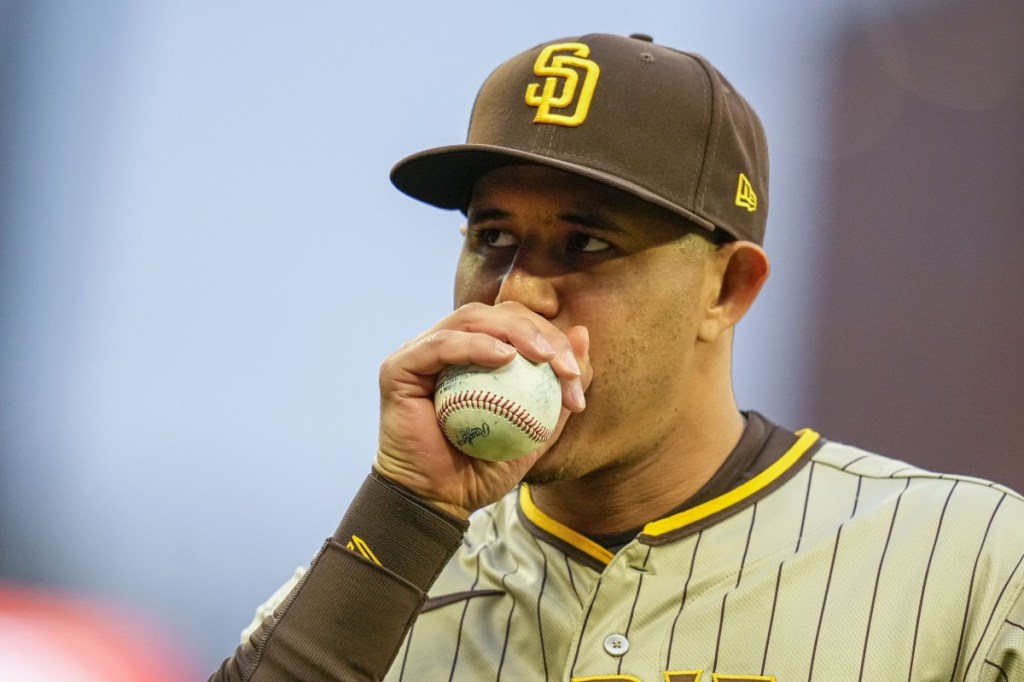
The San Diego Padres entered the 2022 season hoping to make the most of a possible redemption story following their ugly 2021 collapse. And they certainly made the most of it. The Padres would get some of the worst news they’d ever receive with Fernando Tatis Jr. not only breaking his wrist preseason, but being suspended 80 games for PEDs when he was making his way back. But instead of letting this affect the team morale like many events did in 2021, they only got better. They made two huge trades at the deadline when it came to trading for superstar outfielder Juan Soto, and lights out closer Josh Hader. This would be a huge amount of help when it came to the state of the team, and it ended up helping them make their NLCS run later that season. But, they would unfortunately fall short to the Philadelphia Phillies in that series.
Even though they fell short of the World Series title they had been craving, there were plenty of positive takeaways to reflect on following the season. For example, Manny Machado stepped up and became a leader after Tatis was suspended, something baseball hadn’t seen from Manny before. Also, the front office addressed it’s main issues with a struggling bullpen and outfield at the deadline, something they don’t often do. With all of these positives and extensions being thrown around in the off-season, the 2023 Padres looked bright as ever. But, we’re now over half-way through the 2023 season and this couldn’t be further from the case. Why has this team fallen apart so quickly? Where are the problems? What can they do to fix it? In today’s article, I’m going to take a deep dive into all of the San Diego Padres problems, and attempting to figure out why they’re failing
Spending Money in the Wrong Places
The recent trend in San Diego has been to spend money without a clear vision, and I don’t think it’s completely been seen just how damaging this can be to a roster. For example, they finished the season with a rotation that included players such as Blake Snell, Yu Darvish, Mike Clevinger, Joe Musgrove, and Sean Manaea. While it may be true that pitchers such as Musgrove were really solid for the Padres, the complete opposite could be said for Clevinger, and Manaea. With Clevinger boasting an ERA+ of just 87, and Manaea posting a similar mark of 76, it’s easy to see why they failed in the back end of the rotation.
While San Diego was able to get by for most of the season with Musgrove, Snell, and Darvish being good enough to keep them in games, when it came to the postseason this wasn’t the case whatsoever. Although they ranked 5th in the National League in ERA, and other categories, Manaea and Clevinger were hit very badly in the playoffs, becoming a part of why they fell apart in the playoffs.
Along with these struggles at the back of the rotation, San Diego’s offense really fell apart when it mattered. With a lineup consisting of Juan Soto, Manny Machado, and Jake Cronenworth, this should not be the case. But, once you look past the star power, you could see players such as Austin Nola, Will Meyers, Trent Grisham, and Jurickson Profar taking at bats in key playoff spots. Especially with a lot of these guys at the bottom of the order, once the top of the order would get on base, there wouldn’t be anyone capable of driving them in, which left the Padres with a lot of opportunities they didn’t capitalize on.
Given both of these arguments, you can see how the back of the rotation and bottom of the order cost the Padres a lot of games. With the market full of starting pitching, a couple good catchers, and decent outfield options, you’d think that’s where San Diego would have spent their money. But it wasn’t. The Padres spent over $800 million dollars in the off-season when you combine their contracts, and really none of this money was spent to address current problems among the team.
$350 million was given to keep Manny Machado in San Diego, something that had to have been done. And with extensions being handed out to players such as Yu Darvish, Robert Suarez, and Jake Cronenworth, these moves were all really good and well deserved. But, when you take a look at the grand scheme of everything, not much of this $800+ million was spent on new talent. While Xander Bogaerts was brought in on a 11-year, $280 million dollar deal, and Michael Wacha was also added, that was really the extent of the useful talent added in the off-season. Nelson Cruz, and Matt Carpenter were also added, but neither were projectable pieces, and they both showed that this season. Wacha was a surprisingly nice addition to the team, but with him really being the only pitching addition with many departures, I was really scratching my head by this point. It’s important to note that San Diego made huge offers to both Aaron Judge and Trea Turner which could be part of the reason they were spending oddly, but with them landing neither, it felt like Xander was thrown whatever they had left just to say they got someone, even though they didn’t need to improve at shortstop. San Diego instead should’ve targeted pitching, and outfield depth, something they really avoided when it came to their off-season moves. With Yu Darvish aging, giving him such a massive extension was also incredibly confusing. It just felt like San Diego was spending incredibly irresponsibly, especially when they still needed to extend Juan Soto, and when they have their eyes on Shohei Ohtani in the coming off-season. Instead, this reckless spending will likely lead to them not being able to retain Soto, as well as missing out on Ohtani. Along with this, Austin Nola has still been the primary catcher this season because they didn’t upgrade in the off-season, and he’s been worth almost a full -1 fWAR, along with a wRC+ of 37 so far this season. Preller did add Gary Sanchez, but that was only after Nola significantly struggled to start the season.
It’s really confusing to me how a team with so much money to go around still fails to make worthwhile improvements to their roster, while also setting themselves up for a disaster in the future with large extensions to aging players. This really falls on general manager A.J. Preller in my opinion.
A.J. Preller, Josh Stein, and a Front Office of No Opposition
A.J. Preller has been involved in the top of the Padres front office since August of 2014. Obviously, Preller has made some incredibly smart decisions during his time, including trading for Fernando Tatis Jr., signing Manny Machado, and taking the Padres back to the postseason. But, the number one thing Preller has lacked has been trusting in his analytics team, and his coaching staff. And this has been more obvious than ever before since 2021.
It has been widely known for a while now that Preller does not like people who oppose him. The situation in the front office is worse than it’s ever been, and the root of the problems is A.J. Preller. As previously mentioned Preller was told numerous times by his analytics team to stay away from expensive, veteran talent, and he ignored the warnings only for the analytics team to be completely right. The most obvious example of this? The signing of Eric Hosmer. When Preller decided he wanted Eric Hosmer, he went to the analytics team for an opinion. The analytics team reportedly gave Preller a negative report, and when he reviewed it, he told them that the report wasn’t what he wanted, and to find something positive to reason with the signing.
The main thing I’ve gained from reports on the state of the Padres is that Preller doesn’t let departments do their job. He’s constantly trying to be involved in places which he shouldn’t be. For example, he’s always trying to step in when it comes to the analytics departments, player development, and scouting. Preller makes good hirings when it comes to player development, analytics, and more, but they all end up walking out. This isn’t a coincidence, especially when the people who leave typically oppose Preller. In order for San Diego to be successful, he has to catch up to the standards of other teams in terms of development, and also to let departments do their jobs. He has to have some faith in the people he hires, and make good choices. Surrounding yourself with a team of yes-men afraid to lose their jobs because of opposing Preller is a terrible way to run a team, let alone a business in general. The thread I’ve attached below puts all of these points together in a really good way.
Josh Stein is another root of a lot of problems as the thread above mentions. Stein constantly has been the reason for lost talent internally because of the way things are run. Player development and optimization seems to completely disappear in a lot of places in the organization, and this needs to change soon, and change fast. Maybe selling could be a good idea, but when you see the internal problems, what makes people confident they can develop the talent they have in the MiLB? The solution to all of these problems is to clear the house. Preller, Stein, and a lot of the other front office members need to be moved on from. Instead, Bob Melvin will likely catch the blame for the failures of this team, which is just completely unfair. Something major needs to change internally, and fast. If it doesn’t, they’re just asking for failure in the future.
Underperforming Roster
Not only are the glaring issues in the roster construction and in the front office, but the problems also include players on the field who should be key pieces of the roster. As previously mentioned, the pitching staff has been the root of a lot of issues for the past few seasons, and that hasn’t ended this year.
Yu Darvish, someone who has previously been a really good addition to the Padres rotation is significantly struggling this season. Darvish currently has an ERA+ of 87, which is a bad mark especially considering his ERA+ was 122 last season. Darvish has shown encouraging signs, such as a low barrel rate around 6%. But, some of his other metrics have been really dragging him down.
Jake Cronenworth was positioning himself to be a key hitter in this year’s Padres team, but instead, he’s been significantly below league average. With a wRC+ of just 87, and a barrel rate of just 3.9%, it’s easy to see how Cronenworth has really fallen apart offensively this season. Cronenworth is also chasing 25.4% of the time, which is a significant increase from his chase rate of 21.6% last year.
Cronenworth and Darvish certainly aren’t the only ones who have been disappointing this season, but they’re certainly the most prevalent examples of these failures when it comes to expected production. A lot of players who started out slow such as Manny Machado and Juan Soto have significantly turned it around as of late which has been an encouraging thing to see. But with the team failing late in games and losing games they shouldn’t, it’s really hard to see a positive trend upwards when it comes to how they’ve played as a team. This isn’t to say a comeback is impossible, but it’s certainly not likely.
A Plan for the Future
While I would see the Padres trading away Juan Soto as one of the biggest failures in their history, if they know they can’t extend him, it’s the best thing they should do. After the amount of talent they gave up for him in superstar prospects such as James Wood, I would hope they would at least be smart enough to know they’d need to recoup some of their losses in a trade, not just let his contract expire. The Padres are still so close to being the World Series caliber team we expect, so completely selling is pointless for the team.
Maybe the right plan is to sell off the talent on short deals such as Soto, Snell and Hader, and maybe it isn’t. But as previously mentioned, they have so many problems when it comes to player development at the MLB level, that I don’t know if they’d be able to make the most of the talent they’d get back. I do however feel more confident in their MiLB development. I do know that the Padres are capable of being a very smart team, and doing the right things, but they need to show positive improvement soon, or else they’re not looking good for the near future.
The most encouraging thing I see when it comes to the future of San Diego is their ability to develop good prospects. While I’ve been critical of their player development earlier in this article, the problems arrive more at the Major League level. The Padres gave up a ridiculous amount of talent in the last few years when it comes to trading, but they still manage to consistently have 4-5 players in most top 100 lists. These players include, Jackson Merrill, Robby Snelling, Dylan Lesko, Ethan Salas, and Aaron Zavala. With the addition of Dillon Head in this year’s draft, the future is certainly bright in San Diego. But, they have to be smart with their player development, and avoid the same mistakes they’ve made before. If they manage to develop their talent, move on from people internally, and make the most out of their money, they are destined for success. If not, I don’t see a world where the situation in San Diego improves whatsoever.
Final Thoughts
The San Diego Padres have truly never been as talented as they are right now, yet their struggles are larger than ever. They need to make smart decisions when it comes to front office decisions, player development, spending money, and more, or else they’re setting themselves up for failure. It’s time to clear the front office and start from scratch, as that is where the root of most of their problems comes from. But, with these choices being made, there’s nothing this team can’t do. When they play up to their full capabilities, they’re one of the best teams and baseball, and are feared across the league. But when they’re not, they’re arguably one of the most pathetic teams in baseball. Make the right choices, and a World Series ring may only be a few years away. Don’t make the right choices, and you’ll be the laughing stock of baseball for years to come.
 BSBWRITES
Leave a comment