With the 2023 season now finished, and the off-season in full swing, the BBWAA and MLB are set to announce their award winners this week. With this being said, and people tending to disagree with what the BBWAA decide, I wanted to sit down, and give my awards for this season, and a little bit of reasoning to go with that. With that being said, in this article I’ll be going over the MVP Award, Rookie of the Year Award, and Cy Young Award. These are the three biggest awards, so it’s only fit to review these three. Without further ado, I present to you my MLB Award Winners.
Rookie of the Year Winners: Gunnar Henderson and Corbin Carroll
This season was one hell of a season for rookies in the game of baseball, as the amount of new talent entering baseball was a sight to see. However, the finalists named by the BBWAA sparked some controversy. In the American League, the BBWAA named Gunnar Henderson, Triston Casas, and Tanner Bibee. In the National League, you have Corbin Carroll, Kodai Senga, and James Outman. Personally, I don’t disagree with most of the choices on this list. In comparison, my finalists in the American League would’ve been Triston Casas, Gunnar Henderson, and Yainer Diaz. In the National League, they would’ve been, Corbin Carrol, Kodai Senga, and Nolan Jones. However, I would have Gunnar Henderson, and Corbin Carroll taking home this award.
Starting out on the American League side, Gunnar Henderson was not only the best rookie in the American League by a good margin, but he was one of the better players in all of baseball. In his first full rookie season, Henderson hit 28 homers, 9% BB%, .345 wOBA, 123 wRC+, 4.6 fWAR, 52% hard hit rate, and a 11.4% barrel rate. In terms of all players in baseball, Henderson has the 34th highest wRC+ at 123, 25th highest fWAR at 4.6, and the 33rd most home runs at 28. Among rookies with at least 100 games played, Henderson also shines. His 125 OPS+ is the 6th highest among rookies, his 28 homers are the most among all rookies, as well as his 274 total bases being the second most as well. Gunnar also ranks in the top 95% of all of baseball in hard hit percentage, and he ranks in the top 91% in average exit velocity. When comparing Henderson to the other finalists for this award, Henderson has the highest fWAR by far, as Triston Casas’ 1.7 fWAR, and Yainer Diaz’s 2.0 fWAR are much lower than Henderson’s 4.6 fWAR. Although his wRC+ is the lowest of the three, it isn’t by a large margin, as the difference between Henderson’s wRC+, and Casas’ wRC+, is just 6 points. For reference, Casas has the highest of the three. Henderson has hit the most homers out of these three players as well. While you could make a case for all three of these players depending on which areas you look at, Gunnar Henderson is by far the most complete player out of this group, and the areas he trails in just aren’t enough to reason with not giving him the award. Henderson’s 6.2 bWAR led all rookies this season, and he’s the 14th position player to have over 6 bWAR in a rookie season. Gunnar won the American League Rookie of the Year Award while I was writing this as well.
In the National League, Corbin Carroll should be the clear winner of this award, as his 2023 season was one of the best rookie seasons the game of baseball has ever seen. In his first full season, Carroll hit 25 homers, 8.8% BB%, .370 wOBA, 133 wRC+, 6.0 fWAR, 54 stolen bases, and 76 RBI. In his first full MLB season as well, Carroll helped lead the Diamondbacks to the World Series, as he was a huge part of their postseason run. When you compare Carroll to the entire league, there’s a good argument for Carroll to be one of the top 20 players in all of baseball. Carroll had the 15th highest wRC+ in all of baseball, he was tied with 6 other players with 25 homers, second most stolen bases in baseball, and he put up the 9th highest fWAR in the league as well. Since integration, only 45 players have had a rookie season worth 5 bWAR or more and Carroll was one of these players. Among rookies this year with 100 games played, Carroll was tied for the second most home runs, second highest OPS+, most hits, most stolen bases, and most total bases. Carroll’s batting run value was in the 95th percentile, and his baserunning run value was in the 99th percentile. As you can see, Carroll was one of the most productive players in baseball on the offensive side of things. When comparing Carroll to his offensive finalist peer Nolan Jones, Carroll beats him out in certain categories. Carroll’s 6.0 fWAR was higher than Jones’ 3.7 fWAR, Carroll hit more home runs than Jones, Carroll stole more bases, and Carroll had a higher overall batting and baserunning run value. While Jones had a higher wRC+, and wOBA, the gaps were close, and Carroll was overall the better player. When comparing Carroll to Senga, they both had historic seasons, but Carroll came out on top. Senga’s 3.4 fWAR was 21st on the Fangraphs pitching fWAR leaderboard, and he was 5th in baseball in ERA. Senga posted an ERA+ of 142, 29.1% K%, and an overall amazing season. Senga has some of the nastiest pitches in all of baseball, and he has a pitching run value in the 99th percentile. However, I still think Carroll gets the edge in this decision, as he’s my National League Rookie of the Year Award. As of the time I’m writing this, Carroll has just won the award from the BBWAA as well.
Cy Young Winners: Blake Snell and Gerrit Cole
This season was full of a lot of breakout seasons on the pitching end of things. From the likes of Justin Steele, to veterans such as Gerrit Cole, this range of pitchers is really impressive to see. But again, the BBWAA’s finalists sparked some controversy. The finalists for the American League Cy Young Award are, Gerrit Cole, Kevin Gausman, and Sonny Gray. As for the National League finalists, you have, Logan Webb, Zac Gallen, and Blake Snell. It’s nice to see some relatively new faces on this list, including a fan favorite potential repeat in Blake Snell. When I was deciding my finalists, there were a lot of really hard decisions to make. But, I’ve made my decisions. In the National League, I have Zac Gallen, Blake Snell, and Justin Steele. In the American League, I have Gerrit Cole, Sonny Gray, and Kevin Gausman. And out of those 6 players, I have Blake Snell and Gerrit Cole taking home the awards. Without further ado, let’s take a closer look at my reasoning for these choices
In the American League, Gerrit Cole stands out as the clear winner of this award, as he was the best pitcher in the American League by far. In the 2023 season, Cole recorded 222 strikeouts in 209 innings pitched, 165 ERA+, 2.63 ERA, 3.16 FIP, 5.2 fWAR, and a 121 stuff+. Although the Yankees as a team had a lackluster season, Gerrit Cole was one of the huge bright spots on this roster. Cole is arguably the best pitcher in all of baseball, as he topped most of the leaderboards this year. Among starters with at least 100 innings and 60% of their games as starters, Cole’s 222 strikeouts are fifth in baseball, his 2.63 ERA was third in all of baseball, Cole’s 165 ERA+ was third in all of baseball, his 0.981 WHIP was the best in all of baseball, and he overall was one of the better pitchers in the game. Cole’s metrics get even better the further you look into them. His overall pitching run value of 45 was in the 100th percentile, which is the best it could be. Cole’s fastball run value of 29 was also in the 100th percentile, along with his 96th percentile breaking ball run value of 14. Cole is a really good walk limiter as well, as his BB% of 5.8% was in the 87th percentile. His wOBA against was .256, which is really impressive. When comparing Cole to Sonny Gray, and Kevin Gausman, Cole edges them out in plenty of areas. Cole’s fWAR was almost identical to other candidates on this list, as they all sit at 5.3 or 5.2. However, Cole’s ERA, and ERA+ were the best of these three players. As I previously mentioned, all of his pitching run values were some of the best in all of baseball, as his overall pitching run value, and fastball run value were the best of this trio. While his breaking ball run value slightly gets beaten by Sonny Gray, they are still almost on par with one another. Cole’s WHIP is not only the best of these three pitchers, but it’s the best in baseball, making this an easy win for Cole. All things considered, Gerrit Cole is the easiest choice for Cy Young, and the correct choice for this award. With Cole already being an all-star earlier this year, and recording his 2,000th strikeout earlier this year, there’s no better way to cap it off than with a Cy Young Award. The BBWAA agreed as Cole took home this award while I was writing this.
In the National League, this is again a pretty easy choice to make, as Blake Snell was an incredible pitcher this season. This Cy Young Award would be the second of his career, which is a feat not many people can say they’ve accomplished. During the 2023 season, Snell recorded 234 strikeouts in 180 innings pitched, 182 ERA+, 2.25 ERA, 3.44 FIP, 4.1 fWAR, and a 107 stuff+. Similarly to Cole and the Yankees, Snell was a bright spot in for the Padres during their lackluster 2023 season. Also similarly to Cole, Snell topped the leaderboards in most metrics as well. In leaderboards of starters with at least 100 innings and 60% of games as a starter, Snell’s 182 ERA+ was by far the best in all of baseball. In addition to that, his ERA was the lowest in the game, fifth fewest earned runs, best hits per nine, sixth best home runs per nine, and the fourth best strikeouts per nine. Snell is an incredible pitcher, and he was very dominant on all cylinders. Snell’s run value metrics were also stunning, as his overall pitching run value of 44 was in the 100th percentile, along with his breaking ball run value also being in the 100th percentile. His offspeed pitches just missed the 100th percentile mark as well, as they slotted in at the 99th percentile. Snell is a whiff machine as well, as his 37.3% whiff percentage was in the 99th percentile. You can already see just how good Snell was this year, but it gets even more impressive when you take a look at how he compares to the other finalists. Snell’s ERA+ of 182 is the highest mark in baseball as I previously mentioned, and it easily beats out Justin Steele’s ERA+ of 146, and Zac Gallen’s ERA+ of 125. He accumulated more strikeouts, fewer earned runs, a lower ERA, and a much higher percentage of hitters left on base. Steele and Gallen both have Snell beat in the fWAR department, but this is one of the few areas they edge him out in. Snell also has a better stuff+, and Snell also has them beat in his pitching run values that I previously touched on. All things considered, Snell is the easy choice for Cy Young in my opinion, and I choose him to take home this award. Again, the BBWAA agreed as Snell won this award while I was writing this.
MVP Winners: Shohei Ohtani and Ronald Acuña Jr.
Well ladies and gentleman, we’ve reached the most anticipated award of the entire article, the National League, and American League MVP awards. And for the first time ever, both winners were unanimous. Unlike the other awards, the BBWAA’s finalists for MVP didn’t spark as much controversy or debate. On the American League side, the finalists were, Shohei Ohtani, Corey Seager, and Marcus Semien. These players all had fantastic seasons, and I think they were the clear three players who deserved to be nominated for this award. On the National League side, the BBWAA named Ronald Acuña Jr., Freddie Freeman, and Mookie Betts. Again, I really don’t have an issue with any of the finalists that the BBWAA chose. The only player who could be interchangeable is Freddie Freeman, as the Freeman vs Olson debate is a strong one in the analytics community. There’s pros and cons to both, but Freeman likely has a slight edge. This year’s MVP races were a little close in some cases, but I choose the unanimous winners the BBWAA chose as well, in Shohei Ohtani and Ronald Acuña Jr. to take home this award.
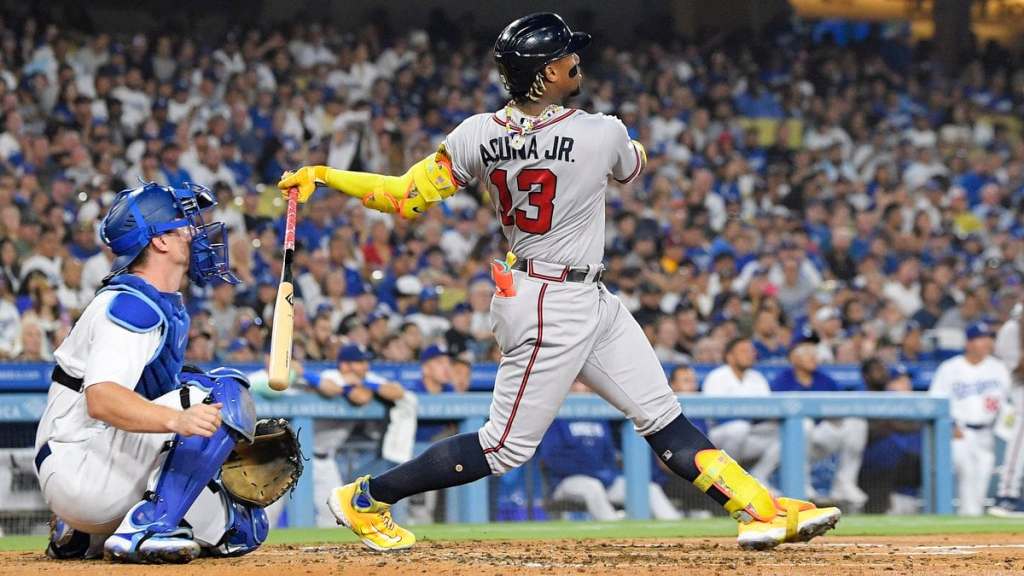
Starting things out with the National League, I believe that Ronald Acuña Jr. should be the choice for National League MVP. But, the race was much closer than most people were led to believe. During the 2023 season, Ronald Acuña Jr. set a lot of records, as his power and speed combination was a sight to see. This past season, Ronald Acuña Jr. hit 41 homers, 10.9% BB%, .428 wOBA, 170 wRC+, 8.3 fWAR, 106 RBI, and 73 stolen bases. The Braves won the National League East once again, but they’d fall short to the Phillies in the NLDS. Acuña is by far one of the more talented hitters in all of Major League Baseball, and this season continued to reinforce this. This year, Acuña ranked second in wRC+, fifth in home runs, tied for first in fWAR, first in on base percentage, second in wOBA, and first in hits. Ronald Acuña Jr. also became the first player in 30 years to have 70 or more stolen bases, with an OBP of .400 or better. Acuña ranked among the league’s best in almost every category. Acuña’s batting run value of 64 is in the 100th percentile, along with his baserunning run value of 2 being in the 86th percentile. His overall batting run value isn’t the only place where he ranks in the 100th percentile, as his xwOBA, xBA, xSLG, and average exit velocity. Acuña is also a hard hit machine, as his barrel percentage of 15.3% is in the 93rd percentile, and his 55.2% hard hit percentage ranks in the 98th percentile. Acuña also barely strikes out as his 11.4% BB% was one of the lowest marks in all of baseball, as it slots in the 97th percentile. He has 3 other offensive traits in the 80th percentile or higher. These include his chase percentage, whiff percentage, and walk percentage. Although Acuña could use some work defensively, his offense is good enough to outweigh this. Acuña really stacks up against his MVP finalists, as Mookie Betts is the only real threat to his National League MVP Award. The race between Ronald Acuña Jr., and Mookie Betts virtually came down to the last few weeks, but with Acuña winning in the end. When it comes to directly comparing the two players, Acuña posted a 170 wRC+, which just barely nudges out Betts’ wRC+ of 167. They posted the exact same fWAR of 8.3 as well. Their stats only get closer as you look closer, as Acuña hit 41 homers, opposed to Betts’ 39 homers. Acuña beats out Betts in K%, stolen bases, average, on base percentage, slugging percentage, wOBA, and hits. I touched on Acuña’s rankings in terms of the rest of baseball earlier, but when comparing him to Betts’ this is only more impressive. Acuña was in the 100th percentile of all of baseball in 5 areas, which is impressive in it’s own right. But, when you look deeper, and see that Betts wasn’t in the 100th percentile in any area. Acuña’s hard hit percentage, and barrel percentage, are also very much higher. These players are much better than the third finalist Freddie Freeman, so there isn’t much to compare on that side of things. When looking at the numbers, I think that without a doubt Acuña should’ve been the MVP, and I’m thrilled with the BBWAA’s unanimous decision to award him the MVP award.
Wrapping things up with the American League, I believe that Shohei Ohtani should be the clear choice to take home the American League MVP Award. If the race came down to offense only, this award would be much closer. But, Shohei Ohtani has the unique ability to pitch as well. Without further ado, let’s get into Shohei’s 2023 season. This season, Ohtani hit 44 homers, 15.2% BB%, .433 wOBA, 180 wRC+, 95 RBI, and 20 stolen bases. However, this is just while he was hitting! Ohtani was also spectacular on the mound, as he recorded 167 strikeouts in 132 innings pitched, 142 ERA+, 3.14 ERA, 4.00 FIP, 1.061 WHIP, 31.5% K%, and a 2.4 fWAR. Just like every other player I’ve written about in this article, Shohei’s name topped the leaderboards in a big way, as he was seen in both the offensive and pitching leaderboards. Ohtani hit the 4th most home runs of anyone in baseball, as his 44 homers were seen above other power hitters such as Ronald Acuña Jr., Luis Robert Jr., and more. In addition, his wRC+ of 180 was comfortably the best mark in all of major league baseball, his fWAR as a hitter was 5th, he had the highest wOBA, highest slugging percentage, second highest on base percentage, 5th in triples, highest OPS, and the highest OPS+. As you can see Shohei Ohtani was by far one of the best hitters in all of Major League Baseball, as well as the American League. This is even more impressive when you remember that Ohtani didn’t play the entire season! Even though he missed a lot of time as a pitcher, he was still seen on the leaderboards there as well. Among pitchers with at least 100 innings pitched, he ranked 36th in strikeouts, 11th lowest ERA, 4th fewest hits allowed, 9th fewest earned runs allowed, 9th best ERA+, 6th lowest WHIP, 2nd lowest hits per nine, and the 8th best strikeouts per nine. All of this is so impressive already given the fact that he can pitch and hit, but the fact that he’s at the top of these leaderboards even with the time he’s missed. Due to Shohei Ohtani being a one-of-a-kind talent, we can only compare Ohtani to his peers offensively. When it comes to the debate offensively, it’s actually closer than you think. Ohtani has the best wRC+ at 180, but it isn’t far off of Seager’s wRC+ of 169. Ohtani posted 6.6 fWAR offensively, which is actually really close to the 6.3 fWAR of Semien, and 6.1 fWAR of Seager. Ohtani led his peers in homers by a significant amount, but Seager’s 42 doubles blow Ohtani and Semien out of the water. Ohtani leads in wOBA significantly, along with his BB%. Although the race isn’t close when you account for Ohtani’s pitching ability as well, the offensive race is closer. But, without a doubt, Shohei Ohtani is my MVP. Again, I’m thrilled with the BBWAA’s unanimous decision to name Shohei Ohtani the American League MVP.
Conclusion
The 2023 season was filled with talent all across the league, and it’s been a pleasure to cover these players in depth all season, and I’m glad that the players I would have chosen were recognized by the BBWAA. These players are the clear winners of their awards in my opinion, and when you break it down I don’t think it’s very close. During this decision, we saw some storylines. For example, Gerrit Cole’s first Cy Young, Shohei Ohtani’s MVP, and more. But, to see these players get the awards they deserve will be a treat for baseball fans all across the globe.
 BSBWRITES
Leave a comment