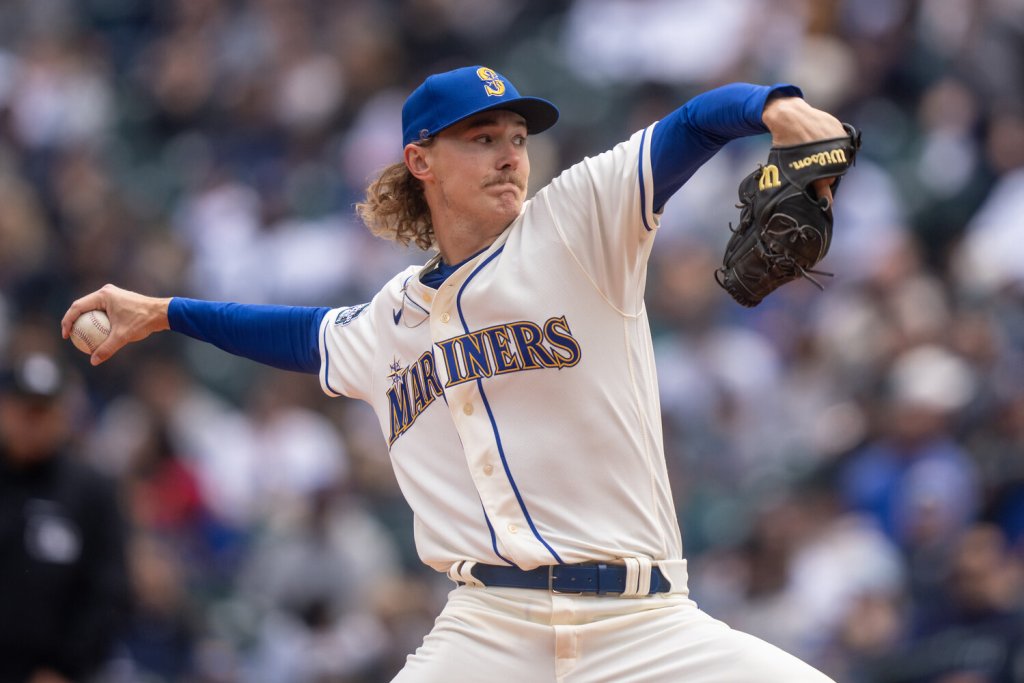
Over the last few seasons, the Seattle Mariners have had quite the influx of pitching talent begin to reach the Major League Level. From George Kirby and Logan Gilbert, to Bryan Woo and Emerson Hancock, the Seattle Mariners have proved themselves to be a pitching development powerhouse. However, one name lurks below the spotlight, Bryce Miller. Miller, a 4th round pick back in the 2021 MLB Draft, quickly became one of the more highly touted pitching prospects the Mariners had in their system. He finally made his MLB debut during the 2023 season, and he would show flashes of greatness. Although he never fully took the leap to stardom, he proved to be a solid arm they could rely on. This offseason, Bryce Miller added a splitter to his arsenal, which in my opinion cements himself as a breakout candidate for the 2024 season. In today’s article, I’ll be showing some other examples where this change really helped pitchers develop and mix their arsenals, and why I think Bryce Miller is next on the list.
A Quick Recap of Miller’s 2023 Season
In order to fully understand where Bryce Miller stood coming into the offseason, we have to reflect on how he preformed in a short sample size last season. Miller would be promoted to the big leagues on May 1st, making his MLB Debut the next day on the 2nd, and from then on his career began. Miller posted a 4.83 xERA, 4.31 xFIP, 22.2% K%, 4.8% BB%, 93 ERA+, and a 1.9 fWAR. Although nothing exactly jumps out about these numbers, they’re certainly encouraging considering Miller only pitched 131.1 innings pitched during his debut season.
Miller’s peripherals were more questionable, as the only place he was at the top of the game in was with his walk rate. Miller didn’t get a whole lot of swings and misses, as his whiff and chase rates were both in the bottom 50% of the league, and he often struggled with barrels and hard hit balls. His average exit velocity of 90.7 MPH, and 10.9 barrel percentage were both in the bottom 10% of the league. He allowed a lot of hard hits as well, as his hard hit percentage sat around a less than stellar 42%.
However, when we focus harder on the good from his first season, Miller’s individual pitch profiles were actually really solid. Most models have Miller registering 6 different pitch types he used to attack batters, and almost all of them showed encouraging signs. Miller gets pretty solid lift on his fastball, as his 18.4 IVB is really solid. His fastball also registered a 121 stuff+ mark, which is the 10th best mark for pitchers with at least 100 innings pitched. His fastball also generated a 105 location+, 27.4% whiff rate, and a 32.2% chase rate. His fastball wasn’t the only pitch he threw well, as his sweeper and slider both registered a 113 stuff+. His sinker and sweepers both profile well also. His curveball showed a profile too, as his -15 inches of IVB were really effective.
Although Miller wasn’t perfect in the time he pitched, he definitely showed signs of being a really good Major League pitcher, and with this only being his first taste of pitching in the MLB, Miller is only going to get better.
Adding a Splitter: Other Success Stories
Adding a splitter to an already pretty solid arsenal is something that’s becoming more and more common over the last few years. One of the most recent success stories? Miller’s teammate, Logan Gilbert. Gilbert added his splitter following the 2022 season, in which he was in a similar place to where Bryce Miller is now. Gilbert’s 2022 season saw him throwing 5 pitches (one fewer than Miller threw this year) and one main thing sticking out which was his pretty solid fastball. Gilbert’s +12 run value on his heater was a decent indication of the pitch being effective despite his fastball only showing a 105 stuff+. His off-speed pitches and breaking balls were also pretty effective, with multiple pitches showing a pretty high stuff+. However, Gilbert was still looking for a breaking ball to push him over the edge, and his newfound splitter seemed to be the answer. And the answer it was.
After adding his splitter, Gilbert saw rises in his strikeout rates, his hard hit percentage decreased, his walks decreased, and the difference between his expected stats and actual stats became much closer than the season before. This was a problem with Miller that I had noticed previously, where his xERA and xFIP were much higher than the actual ERA and FIP posted. For Gilbert, this was the same. In 2022, his xERA was 4.11 compared to an actual ERA of 3.20. In 2023, this gap not only got smaller, but totally changed, His xERA of 3.69 was just lower than his actual ERA of 3.73. I think this is partially due in part to his splitter being added to his arsenal. His splitter generated a little over -7 inches of horizontal break, paired with just 4 inches of vertical break, and just over 900 RPM. The pitch generated a 103 location+, stuff+ just under 100, 34.7% whiff percentage, and a 40.6% chase percentage. Although he only threw it just under 15% of the time, the pitch allowed just 25 hits, an opponent xBA of .167, opponent xwOBA of just .189, making the pitch virtually untouchable.
Another thing that really helped Gilbert’s splitter succeed was it’s ability to play well off of his fastball. Gilbert is excellent at tunnelling, and this was especially obvious when it came to the fastball/splitter combination. With Gilbert being such a great tunneller, his new splitter paired really well with his fastball, making it really hard to pick up. Gilbert being primarily a fastball, sweeper, splitter heavy pitcher is very similar to where Miller will be once his arsenal is adjusted, making these two pitchers even more similar.
Applying the Splitter to Miller
Now that we’ve established where Bryce Miller is currently at in his development, and other success stories with the addition of a splitter to a pitcher’s arsenal, we can now take a look at how this is directly going to impact Miller, and how the development is coming along so far.
Through videos Bryce Miller has been posting on Twitter, we can not just get a look at how the splitter looks to the eye, but with Rapsodo running as well, we can get an idea of how the pitch profiles. Miller’s splitter currently seems to be showing around 962 RPM, -6 inches of IVB, 10 inches of HB, and 83 MPH. Although this is kind of backwards compared to Logan Gilbert’s splitter, they’re still comparable pitches. Gilbert gets more negative horizontal break, opposed to Miller getting more negative vertical break. Long story short, Gilbert’s splitter gets it’s break through armside run, while Miller’s splitter gets more break moving straight down. Bryce Miller is a pretty good tunneler in his own right, so we can expect to see similar results just with less armside run for Miller.
Miller is similar to Gilbert in the sense that his best breaking balls the year before he added his splitter are sweepers and sliders with more gloveside movement. Gilbert and Miller are also both really good at tunneling which makes them even more similar. So with similar pitch shapes, arsenals, and even raw data, these two pitchers are extremely similar, meaning that I think Miller will have similar results once his splitter is used in big league games.
I would also say that Bryce Miller also really needs something with more downward vertical movement, as his only other pitches with this type of movement are below average at best. His curveball is good in terms of break, but it generates really average to below average chase and whiff rates, which is the opposite of what you want to see from this pitch. His changeup is also the worst pitch he throws, as it generated a stuff+ of just 90 with below average chase and whiff rates. So, once Miller fully adds his splitter, he’ll be a good tunneler with a good fastball, good movement horizontally with his sweeper, and good negative movement vertically with his splitter. I don’t know about you, but that combination seems scary to face, and I’m not even going to face Miller this upcoming season.
What to Expect Numbers Wise From Miller with this Change
Given what we saw with Logan Gilbert after the addition of his splitter, I would expect to see many changes with Bryce Miller’s numbers with his new arsenal. Splitter heavy pitchers typically generate a lot of ground balls due to how easy it is to get on top of a pitch moving downward on the way to the plate. With Logan Gilbert, his ground ball rate increased almost 5%, and he only threw it just 15% of the time. We also saw his line drive rate decrease a little over 4% as well. Opponents also didn’t hit the ball as hard either, as his hard hit percentage saw a slight decrease. Given this and Miller already being a fly ball pitcher, I’m expecting to see a sizable increase in his ground ball rate, and probably a decrease in his fly ball and line drive rate. This should make Miller a much more effective pitcher, especially if he sees a decrease in hard hit rate or his barrel rate.
Gilbert also saw a slight uptick in strikeouts with his newfound put away pitch, meaning I think the same is coming for Miller. Miller isn’t currently a strikeout heavy pitcher, so a change in this area would be huge for him as a pitcher, especially if it’s sizable. Gilbert saw a decrease in walks too, but with Miller already being pretty elite in that area, I don’t know how much of a change we’ll see there. I also mentioned earlier in this article that Miller had a pretty sizable difference between expected stats and his actual stats, and that Gilbert had the same issue. For example, Miller’s xERA and actual ERA were a little over 0.50 points different. His xFIP and actual FIP also had a sizable difference of around 0.30. With Gilbert’s expected stats also becoming much closer to his actual stats once his new pitch was added, I again feel a similar result for Miller is coming.
Conclusion
Bryce Miller is a pitcher who already has a very, very high ceiling, and the addition of a splitter which is very effective should help him a lot in his development. With a proven example on his own team in Logan Gilbert, I think it’s an even stronger indication that this is going to work out for Bryce. We’ll have to see if it actually preforms to the profile that I expect it to in 2024, but for right now, I definitely think Miller is a breakout candidate on the rise. It’s just a matter of time.
 BSBWRITES
Leave a comment