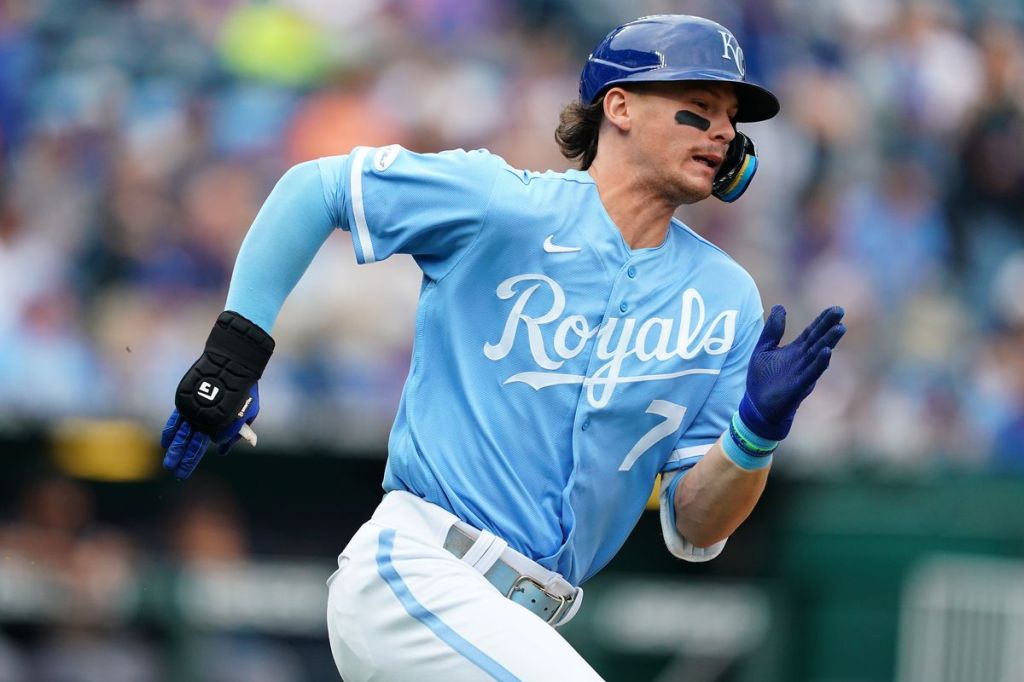
Image Credits: https://www.royalsreview.com/2022/9/13/23350530/can-bobby-witt-jr-improve-his-walk-rate
Ahead of the 2023 Major League Baseball season, I wrote a series of articles centered around players I expected to preform well, and players I expected to regress or fall short of their expectations. In the hitter portion of those articles, I named Kansas City shortstop Bobby Witt Jr. Yet, a year later, Witt has completely transformed his game, now being widely considered as one of the best players the game has to offer. This year, he’s been nothing short of tremendous, and potentially an MVP candidate. In today’s article, we’re going to be taking a deep dive into Witt’s game, and how he’s transformed his game since his rookie season.
Steady Improvements in Quality of Contact
For any Major League Baseball hitter, quality of contact is incredibly important. To put it simply, the more barrels you have, the better your results will be. The fewer barrels you have, the worse your results will be. The best hits are always barreled balls in our game. When it came to Bobby Witt Jr., I was always weary about his ceiling because of his lack of barrels, and subpar hard hit rate.
During his rookie season in 2022, Witt had large expectations to potentially be a 25-30 home run hitter, with plenty of extra-base hit potential. However, his hard hit rate ended up sitting around 38.6% during this season. This was alarming, especially when you consider his 36.2% ground ball rate. While Witt still hits a lot of ground balls, the pairing of softly hit ground balls, as opposed to hard hit ground balls is incredibly different. In addition to his issues with weakly hit ground balls, Witt also severely struggled to barrel up the ball. His 8.7% barrel rate was right above league average, but not incredible by any means. Also, his sweet spot rate of 32.5% was below average. When you factor all of these things in, you begin to see why Witt was struggling. This is of course, without mentioning his other struggles which we’ll cover later on.
Moving into his sophomore season in 2023, Witt began to show a lot of improvements in his offensive game. For starters, Witt turned around his power potential. His hard hit rate improved from 38.6% to 45.6%. While this still isn’t the best in all of baseball by any means, this is a huge difference and improvement for Witt. His barrel rate also saw a sizable increase, as it went from 8.7% to 11.5%. His sweet spot percentage also saw a jump from 32.5% to 34.4%. All of these improvements really helped him improve his game, as Witt went from a below average hitter with a 98 wRC+, to a solid, above average hitter with a 115 wRC+. Thanks to a defensive turnaround that saw his OAA go from -9 to 14, Witt put up almost 6 fWAR. All of this helped Witt finish 7th in the MVP voting, as he showed fans the type of player he could potentially be at his full strength.
Heading into his third year in playing in the big leagues, Bobby Witt Jr., has fully transformed his game, and he’s progressed even further into his breakout. Starting once again with his hard hit rate, he went from 45.6% to 48.6%, which is especially impressive when you see the full improvement of over 10% since his rookie season. His barrel percentage jumped once again, jumping from 11.5% to 14.3%. In fact, Witt went from an average barrel rate, to being in the top 9% of the league in barrel rate. Lastly, Witt’s sweet spot percentage jumped again a little, going from 34.4% to 35.7%. Witt seems to have finally become the hitter we’ve expected him to be this entire time, with his wRC+ now at 152, and he’s already posted a 4.6 fWAR. To put this in perspective, if he plays the rest of this season at this rate, he’ll put up an fWAR of 9.9, which is a huge improvement from what we’ve seen before. And, his improvements to his quality of contact have been a huge factor.
Improvements in Pitch Types
Over the three years that Bobby Witt Jr., has been in Major League Baseball, he’s gotten his fair share of big-league pitching. At times, he’s really struggled to adjust to hitting some of these pitches, which has effected his offensive production.
During his rookie season, Witt was thrown 883 4-seam fastballs. This was just shy of 38% of the pitches he was thrown all season, which was the most out of any pitch type he went up against. Typically, the best hitters in baseball are good at hitting fastballs, but this was not the case when it came to Witt. He hit just .231 against this pitch, which also led to a -8 run value, .303 wOBA, 28.2% K%, and just a 43.1% hard hit rate. To put this in perspective, the best hitter against fastballs in 2024 is Kyle Tucker, who has posted a 15 run value, .476 wOBA, 10.7% K%, and a 52.9% hard hit rate. A lot of Witt’s struggles during his rookie season can be chopped up to his struggles against the fastball, because when you struggle against the pitch you see the most, you don’t often see much success. Witt hit fairly well against the pitch he saw the second post, which were sliders. Witt posted a 6 run value, .312 BA, .363 wOBA, and a 14.7% K%. Opposed to his production against 4-seam fastballs, this was extremely encouraging to see. He struggled against sinkers as well, posting a -5 run value against that pitch as well.
Moving into his sophomore season, Witt made a lot of improvements to how he hit the 4-seam fastball. This was very different from his rookie season, and a huge step forwards. Witt still saw fastballs more than anything, as he saw 911 of them, which worked out for about 33.7% of the pitches he saw. He put up a run value of 3, which is the first time he put up a positive run value against the fastball. He also hit .265 with a .365 wOBA, 24.4% K%, and a 54.3% hard hit rate. As you can see, this was astronomically different from his rookie season. In a surprising turn of events however, Witt seemed to experience somewhat of a sophomore slump against sliders, as he put up a -5 run value against the pitch, which is very different from his run value of 6 during his rookie year. He crushed changeups however, putting up a 12 run value against them. But, overall, this was a solid step forward.
Moving into his current 2024 campaign, Witt has completely revitalized his ability to hit every pitch well. As we’ve laid the ground for, Witt has clearly struggled against fastballs up to this point. However, he seems to be finally on the rise. He’s seen fewer fastballs this year on a rate basis, coming in at just 27.5%, but he’s still faired well against the pitch. He’s currently produced a run value of 4, hitting .297 with a .416 wOBA, 19.4% K%, and a 62.7% hard hit rate. This is completely different from his rookie season, as he’s gone from one of the worst fastball hitters in the league, to a fastball killer in less than 3 full seasons. In addition, he’s back to hitting sliders very well, as he’s posted a run value of 6 against them, while hitting .333, with a .397 wOBA, 18.8% K%, and a 39.2% hard hit rate. Witt has actually posted positive numbers against sinkers, curveballs, sweepers, and splitters. In fact, he’s only shown to have some trouble against cutters and changeups, but I’m honestly not concerned.
All things considered, Witt seems to have really matured as a hitter in Major League Baseball, as he’s progressively ironed out his struggles against hitting the fastball. In my opinion, his struggles against the fastball were a huge factor in what was holding him back. But, now that he’s killing the heater, he’s having a lot more success, as it’s much harder to throw the baseball by them.
Swing Changes
Since he debuted in 2022, Bobby Witt Jr. has arguably one of the most mechanically correct swings in our game. His ability to stay connected throughout his swing is something I’ve always marveled at, but it’s come a long way since his debut. The two swings I’m going to take a look at to demonstrate what I’ve noticed are from his rookie season in 2022, and the current 2024 season.
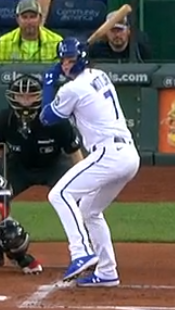
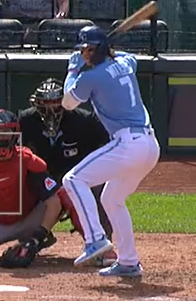
From the beginning of his swing, you may be thinking that the swings look incredibly similar. And, you’d absolutely be correct. However, I do notice that it appears as though Witt has a slightly bigger leg kick during the beginning of his stride, which could help him generate the power he’s suddenly unlocked. Something else I notice is that his back shoulder is now raised, which also generates more power, and allows Witt to stay more connected which we’ll touch on later. His shoulder also being raised leads to a much cleaner path to the ball at contact.
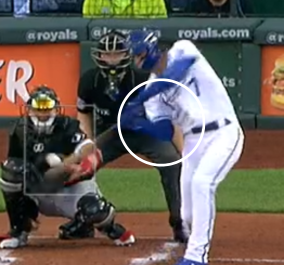
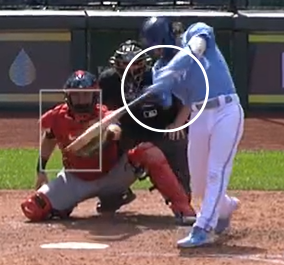
Next, we can see what his swing looks like at contact. What are some things I notice? His shoulder being lowered in the first swing as we established earlier, very obviously leads to a worser path than you’d expect from a hitter with his contact ability. Witt is far less connected in the first swing than in the second swing. Tying this back into his power surge, this would help him stay a lot stronger and develop more power as you see in the second picture. His path to the baseball is far smoother in the second image as well, which would also make it far more difficult to be beaten by fastballs, which we already examined as being an issue. And, from the season where the first image was taken, Witt really struggled to hit fastballs. And now? He’s a great fastball hitter. So, to sum things up, his elbow being up at the beginning of his swing, has led to Witt being more connected, getting through the ball faster and stronger, which has led to his power surge and complete turnaround in how he handles fastballs. All of these things have been key difference makers for Witt, and they’re a result of just one minor change in his swing, which has kept him connected.
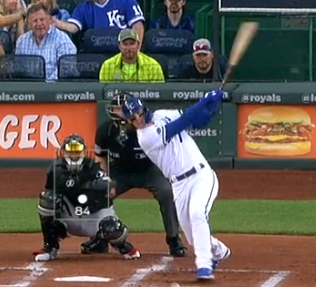
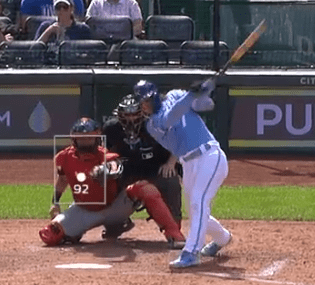
Lastly, we can see the end of the swings we’ve been taking a look at. In the first image, we see the weaker, less connected Bobby Witt Jr. And, from the looks of it, Witt is a lot weaker in his finish as well, which likely led to more rollovers, and weak contact on the ground as well. And earlier in this article, we established that as a problem early on in his career. In the second image, we see the stronger, more connected Bobby Witt Jr., and as you can imagine, the opposite of his other swing is true here. His stronger and more connected swing has led to more hard hit balls, less rollovers, and a lot more power. And this is exactly what we’ve seen from Bobby Witt Jr. as he’s matured as a hitter.
In conclusion, we can see how the minor adjustment to hold his back shoulder up has totally changed his swing, and the results he’s produced because of it. Witt has a better path to the ball, which has led to him hitting fastballs better. Witt has found more power in his connected swing than he had before, and he’s hitting the ball far harder. All of this has completely changed the hitter that Bobby Witt Jr. is.
Conclusion
From my deep dive into Bobby Witt Jr’s career to this point, I’ve seen a few key factors to his recent success as a hitter. His adaptation to hitting fastballs has totally changed his offensive value, his improvements in quality of contact have led to better results, and his swing has led him to be more connected, and a better hitter than ever before. When we pair all of these things together, we see Bobby Witt Jr., preforming the best we’ve ever seen him play in the past. His breakout has been really interesting to watch unfold, and I’m really interested to see how it continues to develop as more time elapses.
 BSBWRITES
Leave a comment