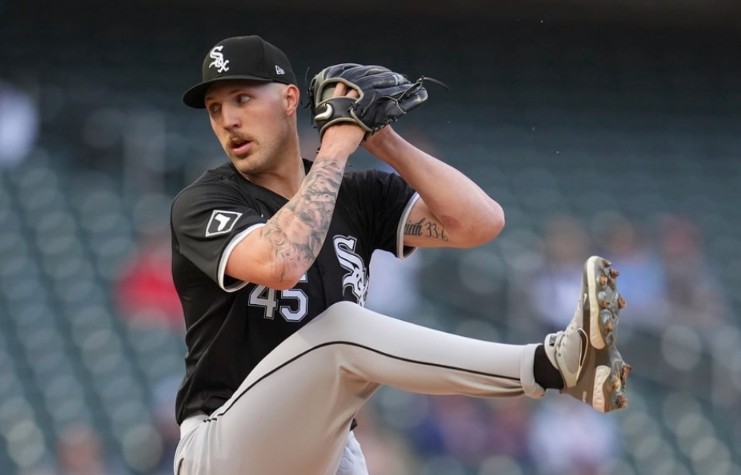
Image Credits: https://images.app.goo.gl/UzXfqotFNEXsHTTA8
Ahead of the 2024 season, the Chicago White Sox were in an interesting position. They haven’t been keen on spending money on the free agent market, and the ownership is preparing to enter a rebuilding phase. Of course, there’s still a team to run on the field but, given the state of the franchise, a lot of uncertainties were clear on the roster. One of them being the rotation. The team signed Erick Fedde to a two-year deal after he pitched well in the KBO however, with the departure of Dylan Cease, it was up in the air. With this, the White Sox turned to a former left-handed first round pick of theirs, Garrett Crochet. Crochet, a reliever up to this point, would be making the transition to the rotation for the first time ever. Although it wasn’t a guarantee at the time, Crochet has blossomed into one of the best starters in the game. And, this is thanks to his newfound cutter, and some other changes to his game. In today’s article, we’ll be taking a look into his breakout, and what has helped him succeed this year.
Crochet Before 2024: Laying the Ground for his Breakout
To this point, Garrett Crochet has had one of the most interesting paths to the Major Leagues out of anyone in our beloved game. Crochet was drafted 11th overall in 2020, out of the University of Tennessee. As you know, this was during Major League Baseball’s 60-game, COVID season. Many of the draft picks from this year found themselves behind, due to the lack of an extra year of development. Yet, Crochet had a very different route, where he was thrown into the Majors almost right after he was drafted. This came as a shock to many, but Crochet did solid during his first taste of professional baseball. He pitched 6 innings across 5 games, recording 8 strikeouts, a 0 ERA, and a 1.02 FIP. Since it was just 6 innings, there wasn’t really much to write home about. Although, we did learn that Crochet would likely slot into the White Sox bullpen as a high leverage flamethrower.
Crochet would move into the 2021 season, looking to pick up right where he left off during his rookie year, but hopefully pick up some more innings in the process. This is exactly what he did, as he pitched 54.1 innings across 54 games. In this time, he would post some very impressive metrics, recording a 28.3% K%, 11.7% BB%, 3.30 xERA, 4.4% barrel rate, 1.4 fWAR, 156 ERA+, .216 xBA, and a .281 xwOBA against him. All of these metrics were incredibly encouraging, especially considering the fact that Crochet was sent straight into the Major Leagues. The most interesting takeaways from his season however, laid in the way his individual pitches preformed. His fastball, which was the thing he was the most well known for, preformed relatively average. It produced a run value of 0, posting an opponent BA of .288, and a .378 wOBA. There is the possibility that he was getting somewhat unlucky however, as his xBA of .277, and xwOBA of .359 were slightly lower than his actual outcomes. His two other pitches however, preformed well, with his slider being worth 5 runs, and his changeup being worth 4 runs. Opponents hit just .141 against his slider, with it producing a 53.2% K%. Overall though, the main takeaways from this season were positive, with Crochet leaning on his slider for a lot of his success.
Crochet would unfortunately hit a road block in his development during his 2022 season, where he would unfortunately miss the entire season due to needing Tommy John surgery. Many waited, intrigued to see how Crochet would continue to develop and adapt at this level, but it would unfortunately be on hold until 2023.
Crochet would head into the 2023 season fresh off of his Tommy John surgery, looking to continue the success he would in 2021. This would be the case, but unfortunately he would be held to another season with very few innings, as he’d struggle off and on with injuries throughout the season. His numbers would be a little skewed due to his lack of time spent on the field, but he was still solid nonetheless. He’d record a 3.55 ERA, and a 128 ERA+, but many of his underlying metrics would be slightly underwhelming. His fastball would once again trend more towards medicority, as it posted a run value of 0, with an oponent xwOBA of .438. This is incredibly underwhelming, especially considering that Crochet was known for his triple-digit fastball, as we previously mentioned. His best breaking ball, his slider, produced averagely, recording a -3 run value, .363 wOBA, and an opponent xBA of .244. His slider wasn’t exactly bad on all aspects, but it wasn’t a great pitch either. But, once again, due to his lack of play, it’s tough to judge. One thing is for certain however, Crochet’s fastball needs to be good for him to succeed, and his slider alone wasn’t going to be enough for him to succeed. He needed another pitch.
The Discovery of his Cutter and Moving to the Rotation
As the offseason between the 2023 and 2024 seasons began, Garrett Crochet knew he needed to develop a new pitch to complete his arsenal, especially with the possibility of him moving into the rotation full time. And with this, came his newfound cutter. As we established when we laid the ground for the 2024 season he’s currently having, Crochet’s fastball was decent, but it wasn’t getting the job done completely. The same can be said for his slider, which had it’s moments of being good, but underperformed most of the time. So, given this, the cutter was the perfect solution.
Crochet said in an interview about his new cutter, “I was throwing it with [Brian] Bannister and he was like ‘Yeah, it’s good, it’s not bad,’ and it would have helped my arsenal with where it was,” Crochet said. “But then I got a grip from [Michael] Kopech and that’s what took off.” Crochet also noted that the off-season goal was to find a pitch with more glove side movement, that could stay in between his fastball and slider when it came to velocity. “I remember throwing that bullpen at Tampa because I didn’t pitch there in that series,” Crochet recalled. “I was going cutter up, cutter down, cutter up, cutter down, cutter up, cutter down. There were six in a row and I was hitting my spots with it and I was ‘OK, this is something I can utilize.’ I can shape it how I want it.”
After he realized it was going to be the cutter that would be the perfect pitch he was looking for, it was officially added to his arsenal. As pointed out in pitching guru Lance Brozdowski’s breakdown of Crochet, the average cutter in Major League Baseball sat around 89 miles per hour, with 8 inches of IVB, and around 2 inches of HB. Crochet’s cutter, has debuted around 6.1 IVB, with around -3.6 HB, and typically coming in at about 91.3 miles per hour. The main thing that stands out about Crochet’s cutter is the velocity of the pitch, making it play more like other fast, cutter throwing, pitchers, such as Emmanuel Clase, or Jose Alvarado. While Crochet is throwing his cutter fast, it’s still done a good job at keeping it’s cutter shape, and not turning into a slower, more hittable fastball. It’s also generated a pretty solid 107 tjStuff+. Something else to note, is that Crochet’s 7.1 feet of extension is in the top 6% of the league, which has been really game changing. The high extension has let Crochet’s cutter appear even faster than it actually is. When you take all of these things into consideration, it shows us just why this pitch has been such a gamechanger for Crochet. He’s throwing his cutter harder than most, while keeping a solid shape with the pitch, and creating a pitch with some good movement to his glove side. All of these factors are exactly what Crochet has been trying to accomplish with this pitch.
The results of this pitch have been fantastic, showing the baseball world that the pitch can show the really good results that we could expect after looking at the pitch’s raw movement profile. So far, it’s been his second most used pitch, being used about 26% of the time. In this timeframe, it’s recorded a run value of 10, which is the 3rd most valuable cutter in the game. The pitch is only behind two of the other best cutters in the game, in Corbin Burnes and Emmanuel Clase. Opponents are hitting just .223 against the pitch, whiffing 37.6% of the time, striking out 36.5% of the time, and registering an xwOBA of just .223. In fact, for pitchers with at least 10 PAs, this is actually the best xwOBA for any cutter in the game, which is extremely impressive. Also, for pitchers with at least 10 PAs, his K% is the 8th best for any cutter in the game, his whiff rate is 7th best in baseball, and his put away percentage of 36.2% was the 8th best in the game. So, it’s fair to say the cutter has preformed as advertised to this point.
Taking a Look at Crochet’s Breakout as a Whole
Aside from Crochet’s cutter, we have to take a look at the rest of his arsenal, and his breakout as a whole. Although the rest of his arsenal have had their problems to this point in his career, this year seems to be an interesting turnaround for his entire pitch mix.
Starting with his 4-seam fastball, it’s been relatively mediocre so far in his career, but this year is a completely different story. Crochet’s fastball shape is interesting. He’s not an incredibly high IVB pitcher like Shota Imanaga, but he’s not a low IVB pitcher like Paul Skenes either. Instead, he sits at an above average 15.9 inches of IVB, which when you pair this with his 8 inches of arm side run, the pitch becomes fairly interesting. Especially when you factor in his average fastball velocity of 96.8 miles per hour, and his elite 7 feet of extension. Not only is his fastball already incredibly fast, but his extension will make the pitch appear much faster than it actually is. This paired with the pitch’s unique shape, make it incredibly hard to hit, and it’s shown with the results this year. To this point, the pitch has been worth 8 runs, which is the most his fastball has ever been worth. It’s generated an opponent batting average of just .164, 28.8% whiff rate, 33% strikeout rate, 106 tjStuff+, as well as a .268 xwOBA. His fastball preforming as well as it has so far has been incredibly encouraging, and a huge key to his success to this point.
His sweeping slider has been another interesting part of his arsenal, as it’s preformed poorly on a run value standpoint. As opposed to his fastball and cutter, his fastball has been worth -6 runs. His slider sits around 84 miles per hour, with just shy of 15 inches of sweep, which ends up being a filthy shape. His sweep is well above average, which is super encouraging to see when paired with the velocity of his sweeper. The pitch has generated an opponent batting average of .244, with a 36.8% whiff rate, 43.5% strikeout rate, 108 tjStuff+, and a .259 xwOBA. It’s interesting that his sweeper has been a point of his game where he’s struggled, due to the pitch’s solid performance in many areas. However, I feel as though he’s getting decently unlucky, since his actual wOBA on his sweeper is .391, as opposed to the xwOBA of .259. All things considered however, I think he may be able to eventually find some more success with this pitch, as actual results start to get closer to his expected results.
Lastly, Crochet has occasionally mixed in a changeup, but due to Crochet not using the pitch much, we won’t dive too much into the pitch itself. The shape is interesting, as the pitch kills a lot of spin. But due to it’s low usage, it’s hard to truly evaluate. The pitch has generated an opponent batting average of .200, a 27.8% whiff rate, 30.8% strikeout rate, .220 xwOBA, and a 103 tjStuff+. The pitch has preformed solid, and I’m looking forward to seeing how it looks over a larger sample size throughout the rest of the year.
All things considered, the way that Garrett Crochet has used his cutter to completely reshape his game has been incredibly impressive. Overall, Crochet has pitched to a 35.2% K%, 5.7% BB%, 2.43 xERA, 127 ERA+, 2.41 xFIP, and a 3 fWAR. This has been fantastic to see, especially with Crochet making the tough switch to a starting pitcher after being a reliever his whole career. At this rate, Crochet has pushed himself on the cusp of being an all-star, and will likely be shipped off to a contender at the trade deadline due to his amazing breakout.
Conclusion
This year, Garrett Crochet was given the tall task of becoming a full time starter after being a reliever his whole career, and he has been shining more than anyone could’ve expected at this. It’s especially impressive, given his injury history as well. Crochet has not only shined, but he took on the tall task of adding a new pitch, and it’s paid off spectacularly. It’ll be interesting to see where Crochet ends up following the trade deadline, but it’ll be fun to pay attention to each step of the way.
 BSBWRITES
Leave a comment